
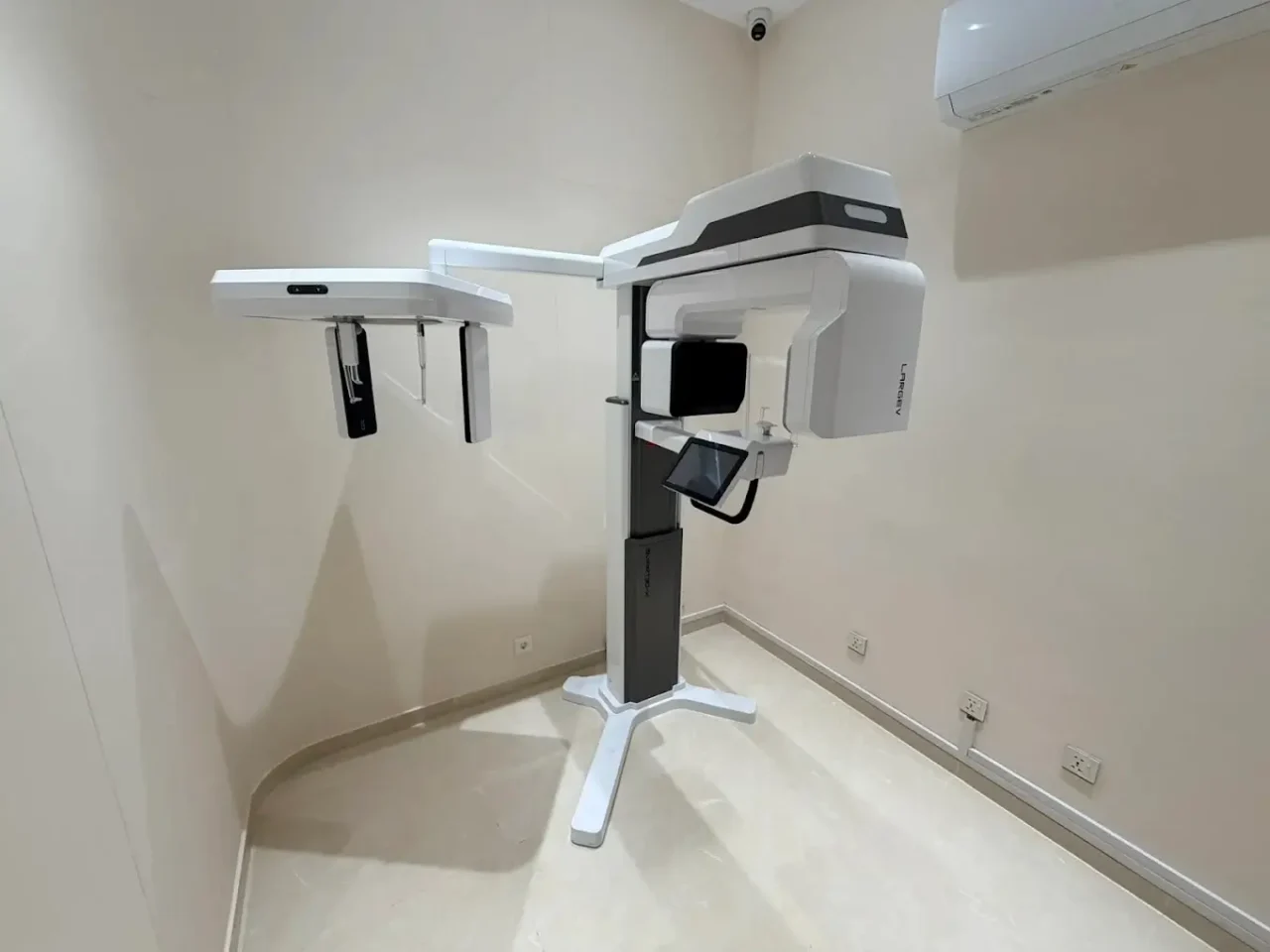
Clear dental treatment starts with clear information. A clinical examination tells the dentist a great deal, but some structures cannot be fully assessed by looking inside the mouth alone. Digital dental imaging helps reveal the position of teeth, the shape of the jaws, bone levels, impacted teeth, root anatomy and other details that may influence diagnosis and treatment planning.
At GloSmile Clinic in Lake City Lahore, advanced in house imaging includes digital OPG, Lateral Ceph and CBCT capability for appropriate cases. This allows the dental team to select an imaging method according to the clinical question instead of using the same scan for every patient. The goal is not simply to take an X ray. The goal is to obtain useful diagnostic information that supports a safer, more precise and more understandable treatment plan.
What Is an OPG Dental X Ray?
OPG stands for Orthopantomogram. It is a panoramic dental X ray that captures a broad two dimensional view of the upper jaw, lower jaw and teeth in a single image. Unlike a small intraoral dental X ray that focuses on a limited area, an OPG helps the dentist review both sides of the mouth together and understand the overall relationship between teeth and surrounding structures.
An OPG can be useful when the dentist needs a wider overview before deciding whether more focused imaging is required. It may support assessment of wisdom teeth, missing teeth, developing teeth, general bone levels, orthodontic concerns and broader treatment planning. Because it is a two dimensional image, it has limitations. Structures can overlap and it does not provide the depth information available from a three dimensional CBCT scan.
What Is a CBCT Scan in Dentistry?
CBCT stands for Cone Beam Computed Tomography. A dental CBCT system rotates around the patient and uses a cone shaped X ray beam to collect data that software reconstructs into three dimensional images. These images can show teeth, bone and maxillofacial structures from multiple views. This additional depth can be valuable when a standard dental X ray or panoramic image cannot answer the clinical question clearly.
CBCT is not intended to replace every conventional dental X ray. Current professional guidance emphasizes that three dimensional imaging should be selected when it is clinically justified and when the expected diagnostic benefit is greater than the additional radiation exposure. At GloSmile, the imaging choice should therefore be based on the individual patient, the area being assessed and the treatment being considered.
OPG vs CBCT Scan: What Is the Difference?
| Feature | Digital OPG | Dental CBCT | Why It Matters |
| Image type | Two dimensional panoramic image | Three dimensional reconstructed image | The required detail depends on the clinical question |
| Coverage | Broad view of teeth and jaws | Selected dental and maxillofacial region in 3D | CBCT can show depth and spatial relationships |
| Common role | General overview and screening support | Detailed assessment for selected complex cases | The dentist chooses the most appropriate view |
| Radiation | Generally lower than CBCT | Typically higher than conventional dental X rays | Imaging should be justified and optimized |
| Planning value | Useful for broad orientation | Useful when 3D anatomy can change treatment decisions | More imaging is not automatically better |
When Can an OPG Be Useful?
A dentist may recommend an OPG when a broad view can help answer the clinical question. The exact need depends on examination findings, symptoms, dental history and previous images. It is commonly considered when evaluating several teeth or both jaws rather than one small area.
- Wisdom teeth and impacted tooth position
- Orthodontic assessment before braces or aligners
- Missing teeth and developing teeth
- General jaw and bone overview
- Initial assessment for some implant cases
- Planning where a wider panoramic view is useful
When Can a CBCT Scan Be Useful?
CBCT can provide extra information when the dentist needs to understand anatomy in three dimensions. The United States Food and Drug Administration notes that dental CBCT may be used for applications such as implant planning, evaluation of abnormal teeth, jaw assessment, endodontic diagnosis and dental trauma. The important point is that the scan should answer a specific clinical question.
Dental Implant Planning
For selected implant cases, three dimensional imaging can help the clinician assess bone dimensions and the relationship of the proposed implant area to nearby anatomical structures. This information may contribute to more detailed planning before treatment begins.
Wisdom Teeth and Impacted Teeth
An OPG often provides a useful broad view of wisdom teeth. If the dentist needs more precise three dimensional information about an impacted tooth and nearby structures, CBCT may be considered where clinically appropriate.
Root Canal Assessment
Many root canal cases can be assessed with conventional dental radiographs. In selected complex situations, CBCT may help the dentist or endodontic clinician investigate root anatomy, previously treated teeth or areas that are difficult to interpret on a two dimensional image.
Orthodontics and Lateral Ceph Imaging
Orthodontic planning may involve an OPG for a panoramic overview and a Lateral Ceph image for evaluation of facial and jaw relationships. CBCT is reserved for situations where three dimensional information is expected to add meaningful diagnostic value. The appropriate combination depends on the individual orthodontic case.
What Is a Lateral Ceph X Ray?
A Lateral Ceph, also called a lateral cephalometric radiograph, is a side view X ray of the head that helps clinicians evaluate relationships between the teeth, jaws and facial profile. It is commonly associated with orthodontic assessment. At GloSmile, having OPG, Lateral Ceph and CBCT capability in the clinic means the dental team can choose among different imaging views according to the treatment question rather than sending every patient for the same type of scan.
What Happens During an OPG or CBCT Appointment?
The process is usually straightforward. Before imaging, the dental team reviews why the scan is being considered and confirms the area that needs assessment. You may be asked to remove items around the head and neck that could interfere with the image. The operator then positions you carefully in the machine and asks you to remain still while the unit captures the required data.
For panoramic imaging, the machine moves around the head to create a broad image of the jaws and teeth. For CBCT, the system collects multiple projections that are reconstructed into a three dimensional data set. The scan itself is non invasive. The dentist then interprets the imaging together with the clinical examination and other relevant records.
Radiation Safety: What Patients Should Know
Dental imaging uses ionizing radiation, so every exposure should have a clinical reason. The American Dental Association and the American Academy of Oral and Maxillofacial Radiology published updated patient selection recommendations in 2026 covering both two dimensional radiography and CBCT. Their guidance emphasizes a clinical examination first and imaging based on the individual patient rather than routine schedules for everyone.
The FDA also advises that dental CBCT should be performed only when necessary to provide information that cannot be adequately obtained with other imaging methods. Exposure settings should be optimized for the patient and the area being examined. This is especially important for younger patients because children and adolescents are more sensitive to radiation.
For patients, a useful question is simple: what clinical question will this image answer? A responsible imaging decision should connect the scan to diagnosis, treatment planning or management rather than using advanced technology without a clear purpose.
Why In House OPG and CBCT Imaging Can Improve the Patient Journey
When clinically indicated imaging is available in the same clinic, the diagnostic journey can become more coordinated. The dentist can examine the patient, request the appropriate image and review the findings within the same care pathway. This may reduce the need to visit a separate diagnostic centre and return with records later.
At GloSmile Clinic, this is particularly relevant for patients considering dental implants, braces and aligners, wisdom tooth assessment, restorative dentistry and other treatments where imaging may influence the plan. It can also be helpful for overseas Pakistanis who are trying to organize consultations and treatment within a limited stay in Lahore. Convenience is useful, but clinical appropriateness remains the priority.
Why Choose GloSmile for Dental Imaging in Lahore?
GloSmile Dental and Aesthetics is located in Business Bay, Lake City Lahore and provides preventive, restorative, cosmetic and surgical dental care alongside modern aesthetic services. Its dental services include general checkups, root canal treatment, dental implants, braces and aligners, crowns, fillings and teeth whitening.
The clinic has advanced digital imaging capability that includes OPG, Lateral Ceph and CBCT for appropriate cases. This supports a treatment approach built around examination, diagnosis and planning before procedures begin. Patients from Lake City, Raiwind Road, Adda Plot, DHA Rahbar, Valencia Town, Bahria Town and surrounding Lahore areas can access dental assessment and imaging within one clinic setting.
OPG and CBCT Scan in Lahore: What to Ask Before Booking
- Do I need an OPG, a CBCT scan or another dental X ray for my specific problem?
- What information is the scan expected to provide?
- Can previous dental images be reviewed before a new scan is taken?
- Will the scan change or clarify my treatment plan?
- For a child or teenager, how will the imaging settings be adjusted to the clinical need and patient size?
These questions support informed decision making and help keep imaging focused on useful clinical information. If you already have recent dental X rays or scans, bring them to your appointment so the dentist can decide whether they remain suitable for the current question.
Frequently Asked Questions
Is an OPG the same as a CBCT scan?
No. An OPG is a two dimensional panoramic X ray that gives a broad view of the teeth and jaws. CBCT creates three dimensional information and is used when extra depth or anatomical detail is clinically useful.
Do I need a CBCT scan before every dental implant?
Not every patient automatically needs the same imaging. The dentist should select imaging after examining the patient and considering the implant site, available records and the information required for planning.
Can CBCT help with wisdom teeth?
It can in selected cases. An OPG may first show the overall position of wisdom teeth. CBCT may be considered if the dentist needs three dimensional information about an impacted tooth and nearby anatomy.
What is Lateral Ceph used for?
Lateral Ceph imaging provides a side view of the head and is commonly used in orthodontic assessment to study relationships between the teeth, jaws and facial profile.
Is dental CBCT safe?
CBCT uses ionizing radiation. When the scan is clinically justified and the exposure is optimized, it can provide valuable diagnostic information. Professional guidance recommends using CBCT only when the expected benefit supports the exposure.
Does GloSmile have OPG and CBCT imaging in Lahore?
Yes. GloSmile Clinic in Lake City Lahore has advanced in house digital OPG capability with Lateral Ceph and CBCT imaging for appropriate dental cases.
Can I book an imaging scan without knowing which type I need?
You can contact the clinic for guidance. A dental assessment may be recommended first so the clinician can decide which image, if any, is appropriate for the problem being investigated.
Final Thoughts
OPG and CBCT imaging can make dental diagnosis and treatment planning clearer when each technology is used for the right reason. An OPG provides a broad panoramic overview while CBCT adds three dimensional detail for selected cases. Lateral Ceph imaging adds another useful view for orthodontic assessment.
At GloSmile Clinic in Lake City Lahore, access to digital OPG, Lateral Ceph and CBCT imaging allows dental care to begin with better visual information when imaging is clinically indicated. Whether the concern involves implants, braces, wisdom teeth, root canal assessment or a broader dental evaluation, the most important step is choosing the image that answers the clinical question with appropriate attention to patient safety.
GloSmile Clinic Contact Information
| Location | C 3 11, Business Bay, Lake City, 13km Raiwind Road, Lahore |
| Phone | +92 325 911 3333 | +92 325 911 3334 |
| Website | glosmileclinic.com |
| Hours | Saturday to Thursday, 2 PM to 10 PM | Friday closed |
Contact
If you have any questions regarding our treatments or services, feel free to email us at info@glosmileclinic.com.
Disclaimer: Above information is subject to change and represent the views of the author. It is shared for educational purposes only. Readers are advised to use their own judgement and seek specific professional advice before making any decision. GloSmile Clinic is not liable for any actions taken by reader based on the information shared in this article. You may consult with us before using this information for any purpose.