
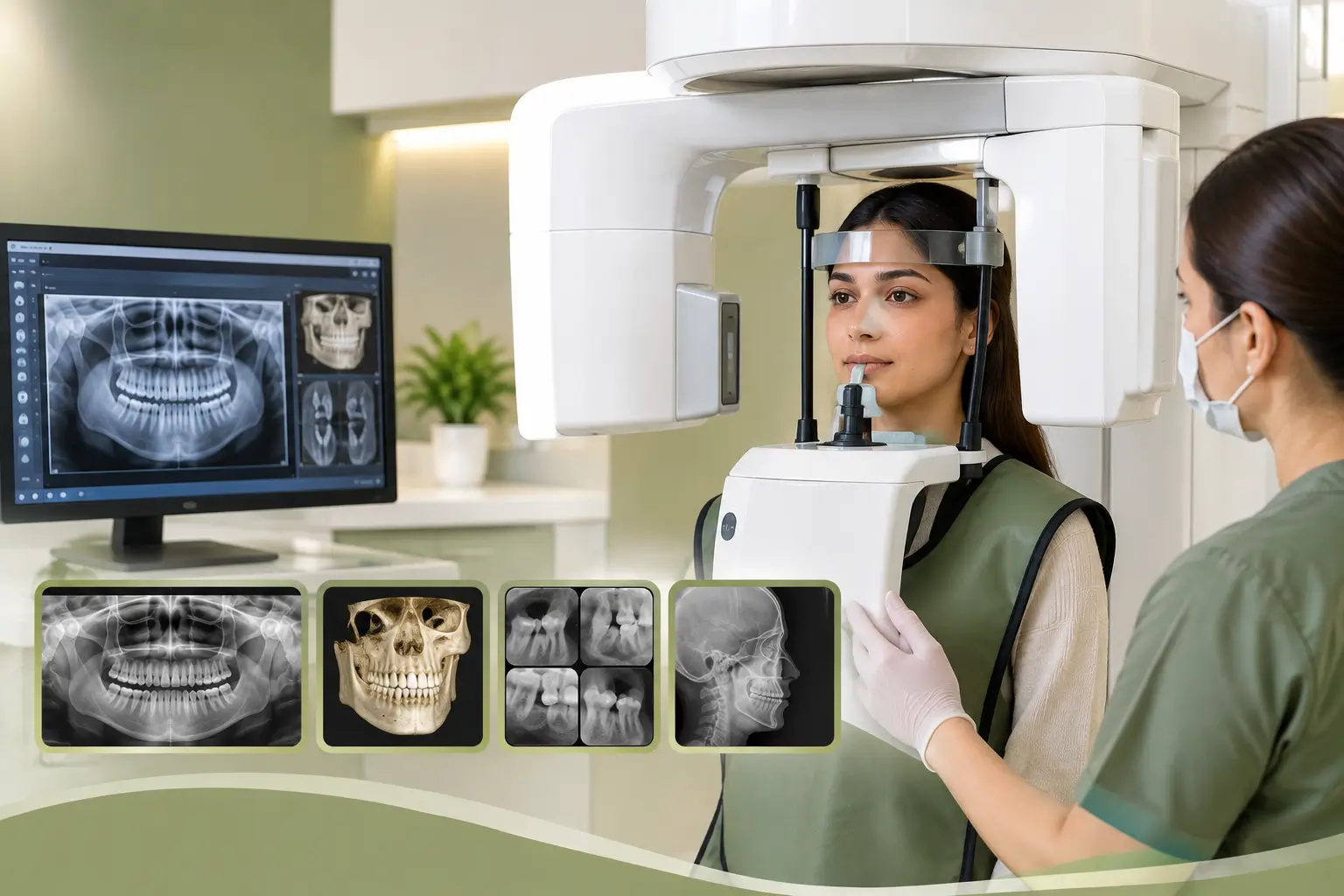
Your dentist tells you that a dental X ray is needed.
Then the names start appearing.
Digital OPG.
Dental CBCT.
IOPA.
Bitewing.
Sometimes lateral cephalometric imaging.
For someone who is not a dentist, all of this can sound far more complicated than it actually is.
The important thing to understand is that these tests are not interchangeable.
Different images answer different clinical questions.
For patients around Lake City, Bahria Town Lahore, Raiwind Road, Adda Plot, DHA Rahbar, Valencia Town, Beaconhouse Society and AWT Phase 2, GloSmile provides Digital OPG and Dental CBCT imaging within its Lake City clinic when clinically appropriate.
What Is Digital OPG?
OPG stands for Orthopantomogram.
A Digital OPG is a panoramic dental X ray.
It captures a broad two dimensional image showing both jaws and most of the teeth in one picture.
Dentists may use an OPG while assessing:
- Wisdom teeth
- Impacted teeth
- Missing teeth
- General tooth position
- Developing teeth
- Orthodontic cases
- Broader jaw structures
Because the image is panoramic, it provides a useful overall view.
It does not provide the same three dimensional detail as CBCT.
What Is Dental CBCT?
CBCT stands for Cone Beam Computed Tomography.
A Dental CBCT scan provides three dimensional information about teeth, roots, bone and nearby anatomical structures.
Instead of looking at only one flat image, the dentist can review the area from different views.
That additional information may matter in selected situations such as:
- Dental implant planning
- Complex impacted teeth
- Difficult wisdom teeth
- Selected root canal problems
- Certain orthodontic cases
- Dental trauma
- Jawbone assessment
CBCT is more detailed but that does not mean every patient needs it.
What Is an IOPA Dental X Ray?
IOPA means Intraoral Periapical radiograph.
This is a smaller dental X ray that focuses on one tooth or a small number of teeth and usually shows the tooth from the crown down toward the root and surrounding bone.
Dentists may use an IOPA when investigating:
- Tooth pain
- Root canal problems
- Infection around a root
- Individual tooth assessment
- Previous root canal treatment
An IOPA and CBCT do very different jobs.
A patient with a straightforward tooth problem may only require a conventional periapical image rather than a three dimensional scan.
What Is a Bitewing X Ray?
A bitewing X ray shows the crowns of upper and lower teeth in the same area.
It is commonly associated with checking certain surfaces between teeth and monitoring particular dental problems.
Again, this is a focused two dimensional dental X ray.
It is not an alternative name for OPG or CBCT.
What Is a Lateral Cephalometric X Ray?
A lateral cephalometric radiograph shows the side profile of the skull, jaws and teeth.
Patients may hear this term during orthodontic assessment because it can help orthodontists study jaw relationships and facial structure.
Whether a particular orthodontic patient needs OPG, cephalometric imaging, CBCT or another combination depends on the case.
OPG vs CBCT for Dental Implants
Dental implants are one of the clearest situations where three dimensional information may become valuable.
An OPG can provide an overall panoramic view.
A CBCT can give the dentist more detailed information about:
- Available bone
- Width and height of the proposed implant area
- Nearby roots
- Surrounding anatomical structures
- Spatial position of the site
This is why many implant patients hear the term Dental CBCT during treatment planning.
The scan does not decide whether someone should have an implant.
It supports the dentist’s assessment.
OPG vs CBCT for Wisdom Teeth
A Digital OPG can be very useful for wisdom teeth.
It can show whether the tooth is impacted, its direction and its general position relative to surrounding teeth.
Sometimes this is enough.
In a more complicated case, a dentist or oral surgeon may want a Dental CBCT to understand the anatomy in three dimensions.
The correct test depends on what information is still needed after examination and initial imaging.
OPG vs CBCT for Braces
Orthodontic planning often involves several types of information.
An OPG may provide a broad overview of tooth positions and developing or impacted teeth.
A lateral cephalometric X ray may be used to assess jaw and facial relationships.
CBCT may be considered for selected situations where more detailed three dimensional information is clinically justified.
Not every braces patient needs a CBCT.
Does Root Canal Treatment Need CBCT?
Usually not as the first step.
Dentists often rely on examination and a conventional IOPA or periapical X ray to investigate individual teeth.
CBCT may become useful when the case is more complex.
For example:
- Unusual root anatomy
- Persistent symptoms
- Previously treated teeth
- Findings that are unclear on two dimensional imaging
This is a good example of why the exact test name matters.
A patient may say, “I need an X ray.”
The dentist needs to decide which X ray.
Digital OPG and CBCT Close to Bahria Town and Lake City
The technical difference between these tests matters.
So does the location.
A patient from Bahria Town Lahore may visit a dentist and then be asked to travel elsewhere for advanced dental imaging.
Someone from Adda Plot, DHA Rahbar, Valencia Town or Raiwind Road can face the same problem.
That means extra travel before treatment planning is even complete.
GloSmile provides both Digital OPG and Dental CBCT in Lake City.
For suitable patients this can make the journey more direct because dental examination, imaging and treatment discussion can happen within the same broader facility.
OPG vs CBCT: The Simple Comparison
A Digital OPG is best thought of as a broad panoramic two dimensional dental image.
Dental CBCT provides three dimensional information.
IOPA provides a detailed image of an individual tooth and root area.
Bitewing imaging focuses on certain tooth surfaces in a smaller region.
Lateral cephalometric imaging is associated particularly with orthodontic analysis of jaw and facial relationships.
There is no single dental X ray that should be used for every problem.
The best scan is the one that answers the clinical question with the appropriate amount of information.
Final Thoughts
Patients should not feel embarrassed asking what test has been recommended.
Ask for the exact name.
Ask what it will show.
Ask why it is needed.
For patients searching for Digital OPG in Lake City Lahore, Dental CBCT near Bahria Town, dental X ray near Raiwind Road, OPG near Adda Plot or CBCT near DHA Rahbar and Valencia Town, GloSmile provides both Digital OPG and Dental CBCT within its Lake City clinic.
You do not need the scan with the most complicated name.
You need the scan that fits your dental problem.
📍 Business Bay, Lake City Lahore
🌐 Online Appointments: glosmileclinic.com
Frequently Asked Questions
1. What does OPG stand for?
OPG stands for Orthopantomogram. It is a panoramic two dimensional dental X ray showing both jaws and most of the teeth.
2. What does CBCT stand for?
CBCT stands for Cone Beam Computed Tomography. It provides three dimensional information about dental and jaw structures.
3. What is an IOPA X ray?
IOPA stands for Intraoral Periapical radiograph. It is a focused dental X ray commonly used to examine an individual tooth, its root and surrounding area.
4. Do braces patients always need CBCT?
No. Imaging is selected according to the individual orthodontic case. An OPG, lateral cephalometric radiograph or other imaging may be sufficient depending on the information needed.
5. Can Bahria Town patients get Digital OPG and CBCT at GloSmile?
Yes. GloSmile in Lake City provides Digital OPG and Dental CBCT imaging for appropriate cases and is conveniently located for patients travelling from Bahria Town Lahore and nearby communities.
Contact
If you have any questions regarding our treatments or services, feel free to email us at info@glosmileclinic.com or call us at +92 325 9113333.
Disclaimer: Above information is subject to change and represent the views of the author. It is shared for educational purposes only. Readers are advised to use their own judgement and seek specific professional advice before making any decision. GloSmile Clinic is not liable for any actions taken by reader based on the information shared in this article. You may consult with us before using this information for any purpose.